Before the era of Agile, organizations and teams worked on projects in a long, cyclic process with later-stage feedback. Requirements were set early and frequently changed, so the output became outdated before final release. Developers focused on building what was documented, not what users needed. This caused delays, wasted effort, and frustration.
So, the business hardly needed a solution for this. Where the role has demanded to align product work with real outcomes and clear priorities. So, the Product Owner role emerged in Scrum to fix this. The PO is the single voice for customers and stakeholders. In this article, we explore the roles and responsibilities of Product owners, help organizations build products that matter to users and the business clearly.
Who is the Product Owner?
A Product Owner (PO) is one of the key people in Agile and Scrum frameworks who makes sure the team builds the right thing and is responsible for maximizing the value of the product at each stage and final delivery. For many professionals, the PO path starts with becoming a Certified Scrum Product Owner, a practical way to build the skills needed to maximize value.
The Product Owner is often called the “single wringable neck” for the product’s success. The Product Owners are singularly responsible and accountable for a product’s success or failure within the Agile framework.
They are often called:
- A “Value Maximizer,” not a “Backlog Clerk”:
Every decision they make is filtered through the question: “Does this deliver the most value to the customer and the business?
- A “CEO of the Product,” but without the authority:
Their primary tools are influence, persuasion, and data rather than command and control.
- Professional “No”-Sayer:
Protects the team from distractions and shifting priorities
- Acts as a Bridge, not a Gate:
Doesn’t just take orders from stakeholders and pass them to the developer. They are a translator and facilitator, connecting the business’s language (ROI, market share, customer satisfaction) with the developers’ language (technical feasibility, story points, architecture).
PO Roles and Responsibilities:
The PO’s main goal is to make sure the team is always working on the most valuable tasks for both the users and the business.
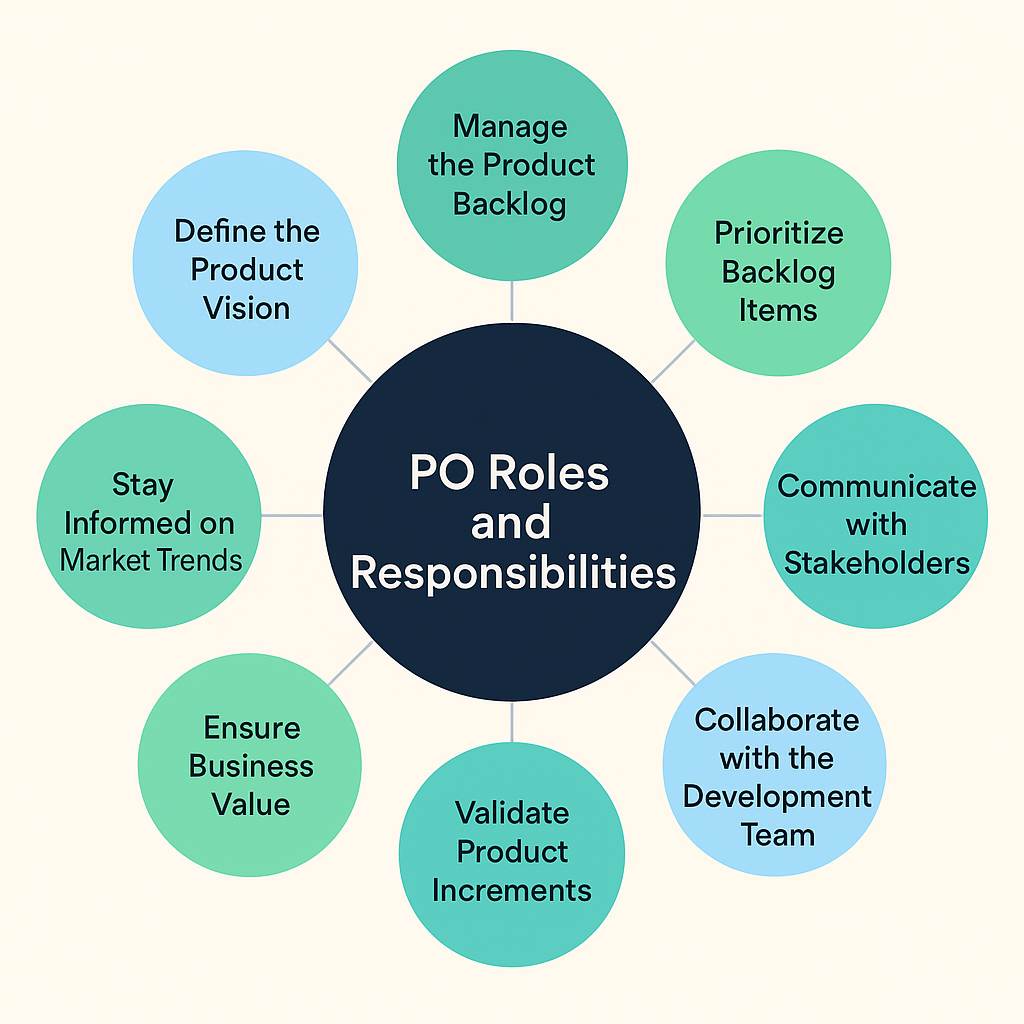
He writes clear items, sets priorities, keeps goals aligned, and turns needs into small, testable user stories. Work with the Scrum Team every day, answer questions responsively at the same time quickly, and make trade-offs when time or scope is tight.
Review progress often, accept what meets the need, and send back what doesn’t. Gather feedback, update priorities, and say no when needed. At last, the goal is simple: ship outcomes that help users and support the business.
| Role | Key Responsibilities |
| Strategic Leader | Sets and shares the product vision and goal.Creates the product roadmap. |
| Backlog Manager | Writes clear backlog items and keeps them ordered by priority. |
| Decision Maker | Decides scope, priorities, and release plans fast.Accepts or rejects work based on the Definition of Done. |
| Stakeholder Liaison | Serves as the main link between customers, users, the business, and the Scrum Team.Manages expectations and reports progress. |
| Team Collaborator | Answers the Development Team’s questions during a sprint.Joins and takes part in Scrum events. |
Why do Organizations Need to Make their Business Valuable?
Organizations must create value to survive and grow. Value brings customers and retains them. That creates revenue. Revenue lets them pay employees, satisfy investors, and fund new ideas. A business that creates value builds market strength, weathers competition, and lasts over time.
How the Product Owner Delivers Value
The Product Owner is the product’s strategic filter. They keep the team focused on the work that delivers real value. They do this in three ways.
1. Prioritizing Ruthlessly:
Keep the backlog clean. Put the highest-value tasks at the top. Use simple scoring to avoid opinions driving decisions.
Example: An early-stage food delivery startup that has a small team had a big list of 100 potential features from founders, early users, and investors. Everyone argued about what to build next. Instead of arguing based on opinions, the PO introduced a simple scoring framework called the RICE Scoring Model:
- Reach: How many people will this affect?
- Impact: How much will it help each person?
- Confidence: How sure are we about our estimates?
- Effort: How much time will it take the team?
The PO scored each feature with RICE.
AI Meal Recommender scored low: low Confidence, high Effort.
Live Order Tracking scored high: big Reach, clear Impact, medium Effort.
They built Live Tracking first. It launched in six weeks. Orders from existing customers rose 15%. Saying “not now” to the AI feature kept the team focused and delivered value fast.
2. Clarifying relentlessly:
Write clear requirements. Answer questions fast. Reduce rework and wasted time.
Example: an e-commerce app had high cart abandonment in guest checkout. Instead of building a full account system, the PO prioritized a focused Guest Checkout MVP. It fit in one sprint and fixed the main problem without heavy work.
3. Validating Continuously:
Accept work only when it meets the team’s Definition of Done. Then gather user feedback. Use that feedback to set what comes next.
Example: The Sales team of the organization asked for a niche feature for one big client. The PO checked the data and complexity. It wouldn’t help most users and would take weeks. The PO said no. That saved the team time and kept momentum on broader priorities.
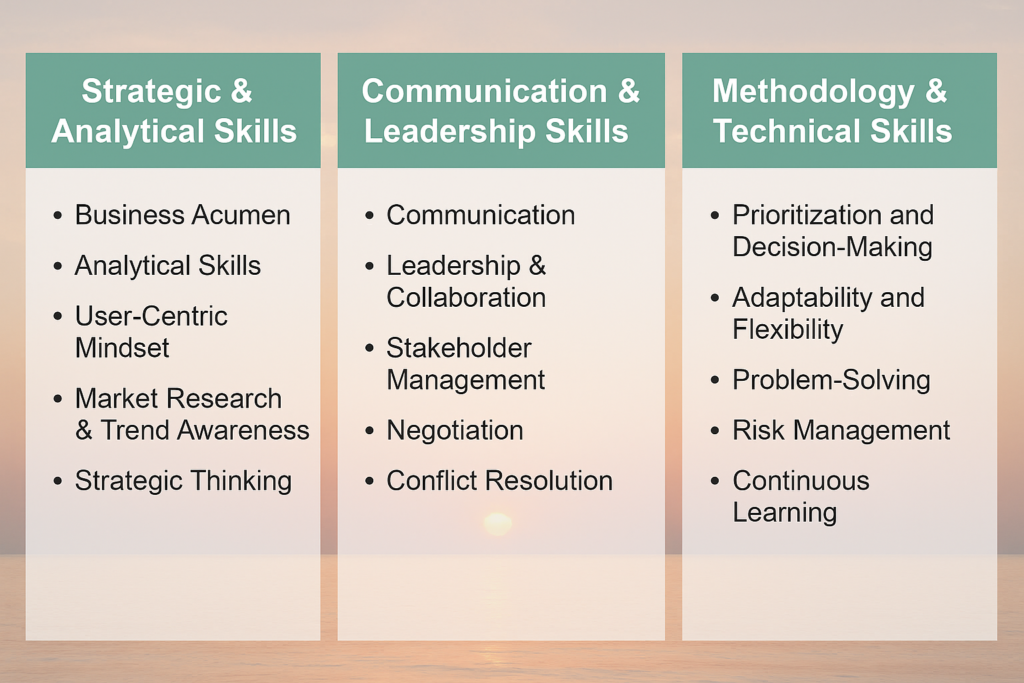
Skills Needed for Product Owners to Maximize Value:
The following valuable skills each and every PO should possess to define and prioritize the right features that meet client satisfaction.
What Happens in an Organization with a Good Product Owner?
An organization that invests in a skilled PO sees transformative results:
- Clear priorities: Teams know what to do next and why. No confusion.
- Faster delivery: A groomed backlog lets the team start work right away. Ideas turn into working software sooner.
- Smarter investment: Each feature links to a business goal. Time and money go to what matters.
- Quick adaptation: The Product Owner collects feedback from users and stakeholders. The team can adapt to change quickly when needed.
- Happier people: Stakeholders feel heard. Teams are protected from chaos and can focus on meaningful work.
Final Thoughts:
As a final thought, I would like to share that Product Owners aren’t just someone who manages only tasks; they are the connectors of ideas and results. They understand what truly matters, making smart trade-offs, and guiding the team toward value-driven outcomes. They help the business grow and succeed. Their choices shape not just products, but the impact those products have on users and the company alike.